11 Realistic Ways on How to Make Money as an Artist (2026)

The “starving artist” stereotype is a thing of the past. Before the internet and social media took off, an artist’s income often relied entirely on gallery exhibitions, which usually required having serious networking connections to even get your foot in the door.
In 2026, making a sustainable living as a creator isn’t about crossing your fingers and hoping a gallery discovers you—it’s about diversifying your revenue streams.
Whether you’re a digital illustrator, a traditional painter, or an artisan crafter, today’s technology gives you access to monetization tools like never before. However, turning your passion for art into a profitable business requires more than just burying yourself in your work; you need a solid business strategy.
In this guide, we’ll break down the 11 most effective ways for artists to make money today. We’ve included actionable steps, profit potential, and expert tips on avoiding common pitfalls so you can start monetizing your art right away.
Contents 13 sections
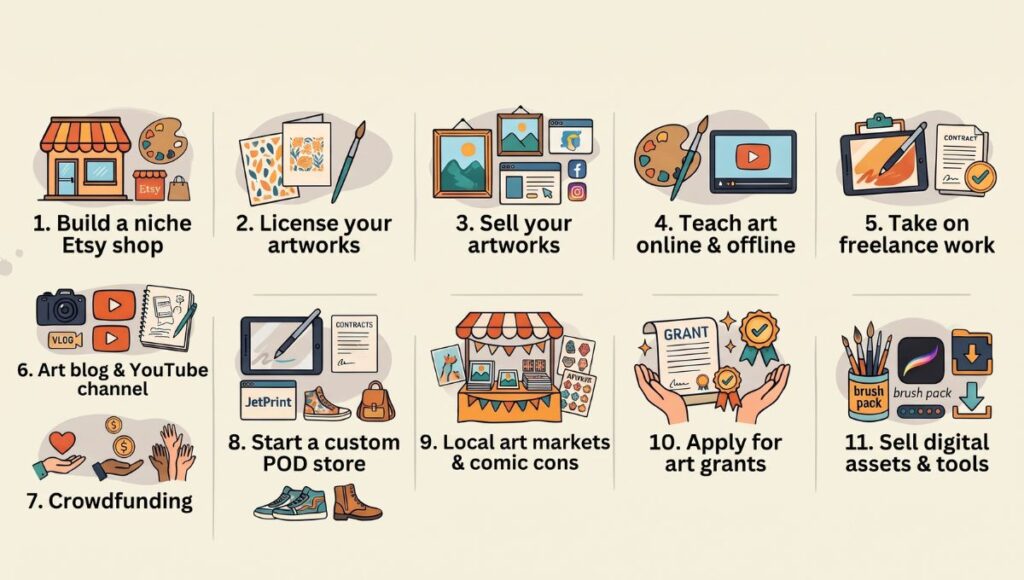
1. Build a niche Etsy shop
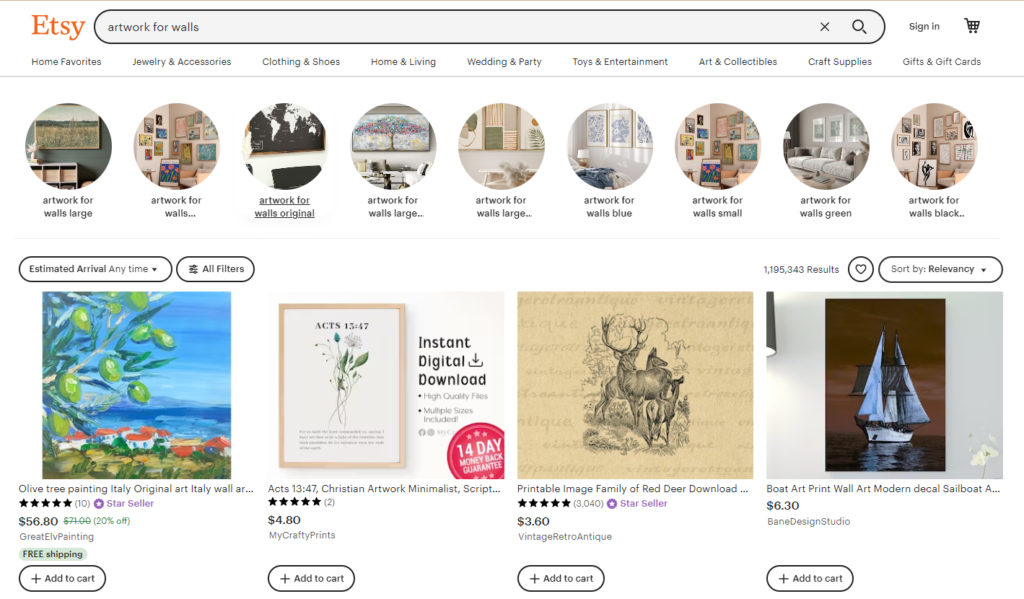
Etsy is still a great platform for artists to make money, but the days of “upload and pray” are long gone. If you want to actually turn a profit now, you need to treat the platform entirely like a search engine.
Pick a specific niche and double down on it—whether that’s custom pet portraits, landscape wall art, or nursery prints. On the practical side, use Etsy SEO tools like Marmalead or eRank to dig up low-competition keywords, and then seamlessly work the exact terms buyers are searching for into your product titles and descriptions. I also highly recommend getting into digital downloads; since there’s no shipping hassle or inventory to manage, it’s practically pure profit after Etsy takes its cut. As long as you can get your search visibility up, the overall profit potential is huge.
2. License your artworks
Simply put, art licensing is essentially “renting” your designs to brands or manufacturers to use on products like greeting cards, fabrics, or home decor in exchange for royalties or a flat fee. The biggest perk of this model is that you get to keep the copyright to your work while letting your partners handle the headaches of production, inventory, and sales.
If you want to break into the industry, the first step is to build a cohesive portfolio of patterns or illustrations. Once you have your work ready, you can pitch directly to art directors at major companies like Target or Hallmark, or scout for networking opportunities at industry trade shows like Surtex.
If the back-and-forth of negotiating contracts with brands sounds like too much of a headache, hiring a professional art licensing agency is a great alternative. They know the ropes and can secure better deals for you, though they will take a cut of your earnings as their commission. Once you land a deal and the products hit the shelves, the profit potential is actually quite solid—artists typically earn a royalty rate of 3% to 10% of the wholesale price.
3. Sell your artworks
Traditional galleries often take up to a 50% commission, which is why more and more artists are choosing to sell directly to consumers online so they can keep all the profits for themselves. While third-party platforms like Saatchi Art or Redbubble do bring in some high-end buyers, your profit margins on these sites are actually incredibly slim—often leaving you with just 10% to 15% of the retail price. In contrast, if you’ve built up a highly engaged and loyal fanbase, selling through your own independent website or directly on Instagram can yield surprisingly high conversion rates.
To actually get started, I highly recommend setting up a professional-looking website using Shopify or WordPress. Make a habit of filming your painting process for Instagram Reels or TikTok, and share the creative stories behind your work. This is vastly more engaging than just posting a plain product shot.
Another crucial detail: always keep your pricing consistent. You can simply stick to the formula of “cost of materials + a reasonable hourly wage” and price your art at exactly whatever that adds up to. Never randomly change your prices based on a gut feeling. Having a reliable, stable pricing structure will help you build trust with collectors very quickly.
4. Teaching art (online and offline)

If you’ve really mastered a specific art medium and developed your own techniques, you should definitely consider monetizing that experience. After all, there are tons of beginners out there more than willing to pay to skip the steep learning curve. Teaching art doesn’t just help you build authority and a solid reputation in the community; it also creates a very reliable, recurring stream of income.
When it comes to actually doing it, you can go the online or offline route. The easiest way to handle the online side is to record a structured video course and upload it to platforms like Skillshare or Domestika. The beauty of this model is that it’s largely set-it-and-forget-it. Once your class is live, it can continuously generate passive income for you down the road. Doing things offline isn’t too complicated, either. You can partner up with local independent coffee shops, community centers, or those casual sip-and-paint studios to rent out the space and host small weekend workshops.
Here’s a highly effective funnel strategy: whatever you do, don’t rush into hard-selling your courses right out of the gate. Start by posting short, 5-minute free tutorials on YouTube or TikTok. Use that genuinely valuable, bite-sized content to build up a foundational, highly engaged audience first. Once you’ve grown that following, it becomes a completely natural transition to pitch your premium, in-depth paid courses—and your conversion rates will be significantly higher when you do.
5. Running an art blog or YouTube channel

Content creation is definitely a long game that requires a lot of hustle, but once you make it through the initial grind, the long-term payoff is absolutely incredible. You can document your daily journey as an artist, do art supply reviews, or shoot immersive studio vlogs. Once you’ve cultivated an audience, your monetization options become incredibly diverse: aside from basic platform ad revenue, you can drop affiliate links in your descriptions for your favorite paints or drawing tablets to earn a commission, and you might even start landing direct brand sponsorships.
When you’re just starting out, the core strategy is to find a hyper-specific niche that no one else is covering. Whatever you do, avoid posting broad, generic “how to draw” videos right out of the gate—you simply can’t compete with the massive, established creators at this stage. Instead, get incredibly specific, like making a dedicated video on “how complete beginners can build rich textures using gouache.”
As for income expectations, this path is the definition of a slow burn, so your initial earnings won’t be very high. You need to mentally prepare yourself to grind consistently for at least six months to a year just to slowly build up steady traffic and baseline views. Only after that foundational phase will you start seeing a substantial and reliable stream of income.
6. Taking on client commissions and freelance work

Whether it’s creating visual identities for brands, designing book covers for authors, or doing custom illustrations for private clients, there’s always a steady demand for commission work. For freelancers, this is the quickest way to bring in money and immediately fix cash flow issues.
When you’re first starting out, you can set up profiles on freelancing platforms like Upwork, Fiverr, or ArtStation to get the ball rolling. But more importantly, carve out a dedicated “Commission Me” page on your personal website. Clearly lay out your pricing tiers, what each package includes, and your terms of service—this will weed out a ton of tire-kickers and back-and-forth emails. Also, here’s a non-negotiable rule in the industry: never sketch a single line until you’ve collected a 50% non-refundable deposit. That way, you ensure your time and effort don’t get wasted.
7. Crowdfunding
If you’ve already built a core base of die-hard fans, crowdfunding lets your biggest champions put real money directly behind your art to keep you going.
If you’re looking for a steady, reliable monthly income, Patreon is your best bet. You can have supporters pledge anywhere from $3 to $15 a month and reward them with exclusive perks—like behind-the-scenes looks at your creative process, first dibs on original pieces, or a monthly physical sticker pack. On the other hand, if you’re launching a big one-off project—like publishing a full art book, producing a custom tarot deck, or manufacturing a run of enamel pins—Kickstarter is a much better fit. As long as your concept hits the sweet spot for your audience, a single round of pre-orders from your super-fans is usually enough to easily cover your upfront production costs.
8. Start a custom POD merch store
When it comes to selling physical merch, Print-on-demand is hands down the lowest-risk way to test the waters. All you do is upload your designs, and as soon as a customer places an order, your backend POD supplier takes care of the printing, packing, and shipping. There’s zero inventory, zero upfront costs, and you don’t even have to make a trip to the post office.
Getting started is super simple: just link your Shopify, Etsy, or WooCommerce store directly to a reliable POD supplier like JetPrint. While most platforms out there are still fighting over basic graphic tees, JetPrint’s edge is that they let you put your designs on unique, high-margin items—like custom sneakers, boots, and vegan leather bags.
Here’s a pro tip: make sure you take full advantage of JetPrint’s built-in 3D mockup generator. You don’t need to spend a dime on physical samples to get incredibly realistic product shots for your social media feeds. If you pair this with Gemini to generate matching lifestyle scenes and models, the visuals will be incredibly eye-catching and really drive customers to hit the buy button.
9. Set up a booth at local art markets or comic cons
Selling in person isn’t just about networking and making money—it’s also a great opportunity for market research. You can see firsthand which pieces catch people’s eyes the most, and this genuine feedback can be incredibly inspiring for your future work.
Keep an eye out for local craft fairs, comic cons, or festivals, and rent a small booth. When setting up, it’s a good idea to use a tiered pricing strategy: mix higher-priced original artwork with more affordable merch (like prints, postcards, stickers, or enamel pins). That way, no matter what a customer’s budget is, they can find something they love to take home.
10. Apply for art grants and enter competitions

Every year, plenty of government agencies, private foundations, and arts organizations offer financial support to independent artists. These grants aren’t loans, so you don’t have to pay them back; they’re mainly designed to fund a specific project or relieve some financial pressure while you create.
You should regularly check database sites like Artwork Archive or NYFA to keep an eye out for open grant applications.
Here’s a quick tip: the application process can be pretty tedious, so it helps to treat it like a part-time job. It might be a hassle, but look at it this way—if you manage to score a $5,000 grant, you can spend the next few months completely focused on your art without worrying about paying the bills.
11. Sell digital assets and creative tools
If you primarily do digital art, you can absolutely bundle your go-to creative tools and sell them. This includes custom Procreate brushes, Lightroom presets, vector graphics, or even fonts you’ve designed yourself.
Take some time to organize your favorite and most effective brush sets or texture packs, and list them on platforms like Creative Market or Gumroad, or sell them directly on your own website.
The return on investment for this is huge. After all, you only have to create a digital file once, and then you can sell it an infinite number of times with zero overhead costs.
Final thoughts
In today’s world, making money isn’t actually that hard for truly talented artists. What we usually lack is a business mindset. Take a look at how artists in other niches who have already cracked the monetization code are doing it; even if you just mimic them at first, you definitely won’t starve.
In 2026, making a living from art really boils down to “income stacking.” Stop grinding away exclusively on Etsy, and don’t bank everything on gallery shows. You need a two-pronged approach: bring in active income through freelance gigs and art fairs, while layering on passive income streams like art licensing, print-on-demand merch shops, and digital downloads.
My advice is to pick two avenues from this list and double down on them this quarter. Learn the ropes and get them generating revenue on autopilot before you consider adding a third.
FAQ
Can you actually make money as a beginner artist?
Absolutely. A lot of people just starting out make their first real money by doubling down on a specific niche or selling affordable small items. For instance, you could set up a print-on-demand merch shop using JetPrint, or just sell digital files on Etsy. Monetizing your early work this way means you don’t have to tie up your cash in inventory, so it’s basically risk-free.
How much does an independent artist make a year?
The range is huge—it really just depends on your business savvy and how you monetize. A beginner doing freelance commissions might pull in around $15,000 to $30,000 a year doing the grunt work. But once you figure things out and combine income streams like art licensing, selling online courses, and running a POD store, hitting $70,000 to over $100,000 a year is actually pretty common.
What type of art is the most profitable to sell?
In the current market, a few specific categories offer the best margins. First is highly customized work, like private portrait commissions. Second is digital assets tailored to hyper-specific niches, like a killer set of Procreate brushes. And finally, highly stylized physical merch, like custom-designed shoes or fridge magnets. For independent creators, focusing on these is usually the best way to maximize profit margins.

Submit a Comment