Printful vs Printify: Read This Before You Start Your POD Store
When it comes to running a successful print-on-demand business, your supply chain will make or break you. And if you’re in this space, you inevitably run into the ultimate question: Printify or Printful?
Maybe you’ve already been burned by one of them—like receiving a product that looked nothing like the mockup or feeling like the quality just didn’t justify the price tag. Or maybe you’ve watched a million comparison videos online and ended up more confused than when you started. There’s no denying that these two are the undisputed giants of the industry, and they both integrate seamlessly with major e-commerce platforms like Shopify, Etsy, and WooCommerce. But beneath the surface, their underlying operating models, pricing strategies, quality control, and branding options are completely different beasts.
If you’re still torn between the two, hold off on making a decision just yet. In this article, I’m cutting the fluff and breaking both platforms down from top to bottom, backed by hard lessons and hands-on feedback from real sellers. The goal of this guide is to give you absolute clarity, so by the time you finish reading, you won’t need to run another search.
Contents 8 sections
Core Differences in Production & Fulfillment
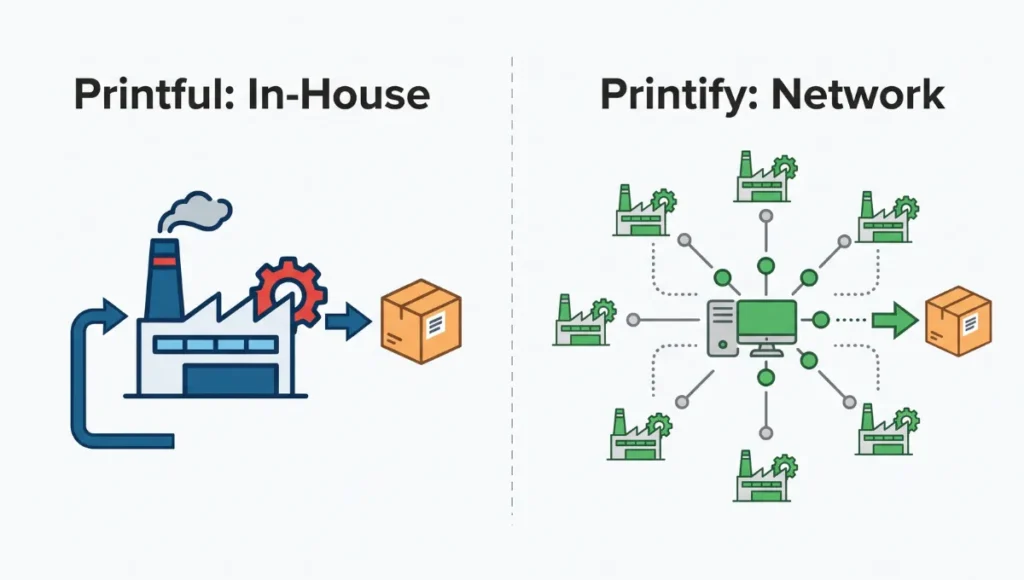
To really grasp the difference between Printful and Printify, you first have to understand their completely different underlying business models. This dictates exactly how your items get printed and shipped once an order rolls into your store.
Printful: The Asset-Heavy “In-House + Managed Partner” Model
They take an asset-heavy approach by running their own facilities. The second a customer places an order, it syncs directly to one of Printful’s in-house fulfillment centers worldwide (like in North America, Europe, or Oceania) or to one of their strictly vetted partner facilities. Because they manage the factories themselves, they have total control over the entire production line, machine maintenance, and even the exact type of ink used.
But here’s a little insider tip you should be aware of: nowadays, Printful doesn’t print everything in-house anymore. If you want to know for sure whether a specific product is actually made in their own facilities, you have to check the “Source” at the very bottom of the product page. Frankly, the POD market is so wildly competitive right now that Printful has had to compromise, farming out more and more orders to third-party contractors.
Printify: The Asset-Light “Middleman Marketplace” Model
In stark contrast to Printful, Printify is essentially a matchmaking platform. They don’t own a single print shop themselves. Instead, they’ve brought over 140 independent print providers of all sizes from around the globe (like Monster Digital, Textildruck Europa, and SwiftPOD) under one roof. The biggest perk of this model is flexibility: for the exact same basic t-shirt, you can shop around to see who offers the lowest cost, who is geographically closest to your customer, or who has the fastest turnaround times, and then decide exactly which provider gets the order.
Profit Margins
At the end of the day, running an e-commerce business is all about the numbers, and your profit margins are what keep you alive. When it comes to actually making money, these two companies take completely different paths.
| Core Metric | Printful | Printify |
| Base Product Cost | On the higher side (costs include strict QC and extra services) | Lower (leaves room to compete on price or push for high margins) |
| Paid Subscription Plans | Printful Growth ($24.99/month) | Printify Premium ($39/month for up to 20% off base prices) |
| Margins & Positioning | Margins are tighter; better suited for premium branding with higher markups | Highly flexible pricing; ideal for volume sales, price wars, or maximizing per-item profit |
If your core business strategy is competing on price, or if you simply want to squeeze the highest possible profit margin out of every single shirt, Printify is clearly the way to go. Thanks to its supplier network model, their base product costs are just naturally lower. This is especially true once you start bringing in steady sales every month; shelling out $39 a month for a Printify Premium membership gets you a 20% discount across the board. When you do the math, the cost savings are substantial.
On the flip side, Printful’s base prices are undeniably on the higher end. The reason is simple: they bake the overhead of their strict in-house quality control, a dedicated customer service team, and globally standardized packaging right into the base cost of every single garment. Because of this, sellers who choose Printful generally can’t survive by racing to the bottom on price. Instead, they have to focus on building a strong brand premium and taking a more high-end approach to offset those extra costs.
Product Quality
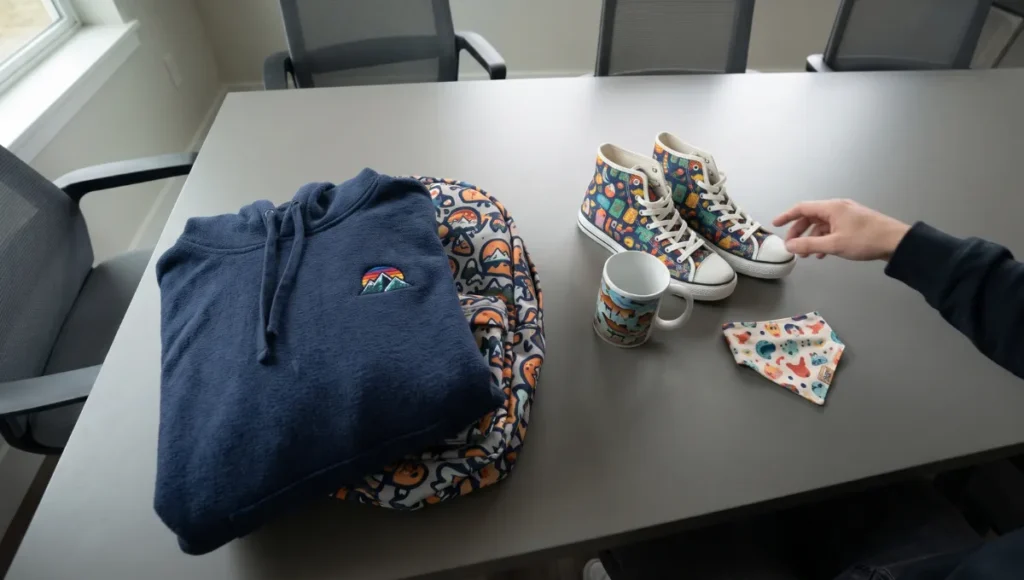
In ecommerce and running your own store, product quality is your lifeblood—it’s directly tied to your refund rates and customer retention.
This is where Printful really shines. Because they control their own factories, their consistency in color accuracy, print durability, and stitching details is insanely reliable. Whether a customer orders from California or Berlin, the hoodie they receive will look and feel virtually identical. If you’re aiming to build a premium brand or just want to minimize customer service headaches and refunds, this level of consistency is your biggest safety net.
On the flip side, with Printify’s supplier network model, your quality completely depends on which print provider you go with. Some of their top-tier providers can easily match or even beat the quality of an in-house factory. The catch? Their “Order Routing” feature. If your primary provider goes out of stock and the system automatically routes your order to a backup facility, the final product your customer receives might have slight variations in print color or placement. Because of this, if you’re using Printify, don’t nickel-and-dime it in the beginning—you absolutely have to order samples from multiple providers to test the waters yourself, and always keep a close eye on provider ratings.
Of course, regardless of which model you choose, paying out of pocket to order sample products before officially launching is a must. You need to get your hands on the physical item to know exactly what you’re selling. Don’t try to save a few bucks on samples only to take a massive hit on refunds later.
Product Catalog
When it comes to product selection, you first need to evaluate your brand positioning: are you planning to stick to standard apparel, or are you looking to dive into highly specific niche items?
Printful takes a “quality over quantity” and “deep customization” approach. While their overall product count is relatively small, they are heavy hitters when it comes to premium customization options, like all-over prints (AOP) and embroidery, and they are very strict about fabric selection. Their blank products often have a higher fabric weight and feel much closer to true retail brand apparel.
Printify’s trump card, however, is a massive and wildly creative catalog. Beyond the standard run-of-the-mill t-shirts, hoodies, and mugs, you can find off-the-wall merchandise like shoes, car floor mats, puzzles, and even custom pet clothing. This is perfect for sellers who want to scale their store quickly with a ton of designs or test out unconventional niches.At the end of the day, though, comparing catalog sizes only really matters if you are dead set on exclusively using one platform over the other. If you’re already mixing and matching multiple suppliers (just using whoever has the right product for the job), you can completely ignore this point.
Branding & Packaging
The moment a customer opens their package—the unboxing experience—is actually your best opportunity to win them over and build brand loyalty.
When it comes to white-label shipping, Printful’s attention to detail is absolutely top-tier. Not only can you customize the inside labels of the garments, but you can also toss in your own custom pack-ins, like thank-you notes and branded stickers. You can even customize the inner and outer packaging, as well as the return address on the shipping label. With all of this in play, the customer has absolutely no idea a third-party fulfillment platform is working behind the scenes, which is incredibly crucial for building your own brand identity.
In comparison, Printify falls a bit short here. While they do support basic inside label customization, their underlying supplier network is just too massive and fragmented. Currently, only a very small handful of specific print providers support custom additions like pack-ins.
Customer Support
How fast and helpful your customer service is directly dictates whether a customer will ever buy from you again.
Based on my own testing, the attitude of the support teams at both companies is pretty much a toss-up. You’ve probably seen plenty of rants on forums about a certain company’s support dragging their feet. To be completely honest, that kind of mess happens with both of them.
Right now, both Printful and Printify offer live web chat. But, as usual, you have to jump through a few hoops with their chatbot before you can actually reach a human.
What I really want to highlight is the response time when I tested them via email: Printful makes you wait noticeably longer. Printify’s response time, on the other hand, is genuinely impressive; even factoring in time zone differences, they usually manage to get back to you in about two hours.
Final Thoughts
At the end of the day, in this Printful vs. Printify showdown, there is no absolute right or wrong answer. However, if neither platform feels like the perfect fit for your brand, you can always explore other reliable Printify alternatives. Blindly trashing either platform is just a rookie move. As a quick side note, I didn’t bother comparing their platform integrations in this article because there’s really no need—both of them already seamlessly integrate with pretty much every major ecommerce platform you can name.
What really dictates your choice is which platform better aligns with your current business stage. If your top priority is maximizing profit margins, and you don’t mind getting your hands dirty testing products and managing various suppliers, then Printify’s clear cost advantage will definitely give your cash flow a lot more breathing room. However, if you’re dead set on building a premium independent brand, want to pour all your energy into design and marketing, and have zero tolerance for stressing over inconsistent quality control or customer service disputes, then an in-house platform like Printful—with its rock-solid quality consistency and top-tier custom packaging—is a much smarter long-term investment. Take a look at your initial budget, figure out your profit expectations, and ask yourself how much tolerance you have for fluctuations in product quality. Once you do that, the answer will reveal itself.
Finally, just being completely real with you: trying to genuinely establish a brand using the POD model is actually quite tough. It requires crystal-clear market positioning and a willingness to invest real money. If you want to dive even deeper, we’ve put together another in-depth, no-fluff guide on How to Start a Print-on-Demand Business from Scratch, which will help you get a much better grip on the underlying mechanics of this market. Hopefully, this post helps you avoid a few bumps in the road!
FAQ
Can I use both Printful and Printify in the same store?
Absolutely! Tons of POD sellers use both platforms simultaneously. You can actually integrate multiple POD suppliers into your store all at once.
Which platform is better for an Etsy beginner?
Both platforms integrate seamlessly with Etsy. As far as convenience goes, it’s a tie. But for total beginners on a tight budget, Printify usually has the edge because its base costs are lower.
Is Printful really more expensive than Printify?
Yes. Printful’s base prices are higher, but that’s because they bake in the costs of their strict in-house quality control, along with premium material and packaging options.
Are there other POD companies worth considering?
Definitely. The market is packed with POD companies. You can check out this article on print-on-demand companies for more options. Different companies just specialize in different types of products.


Submit a Comment